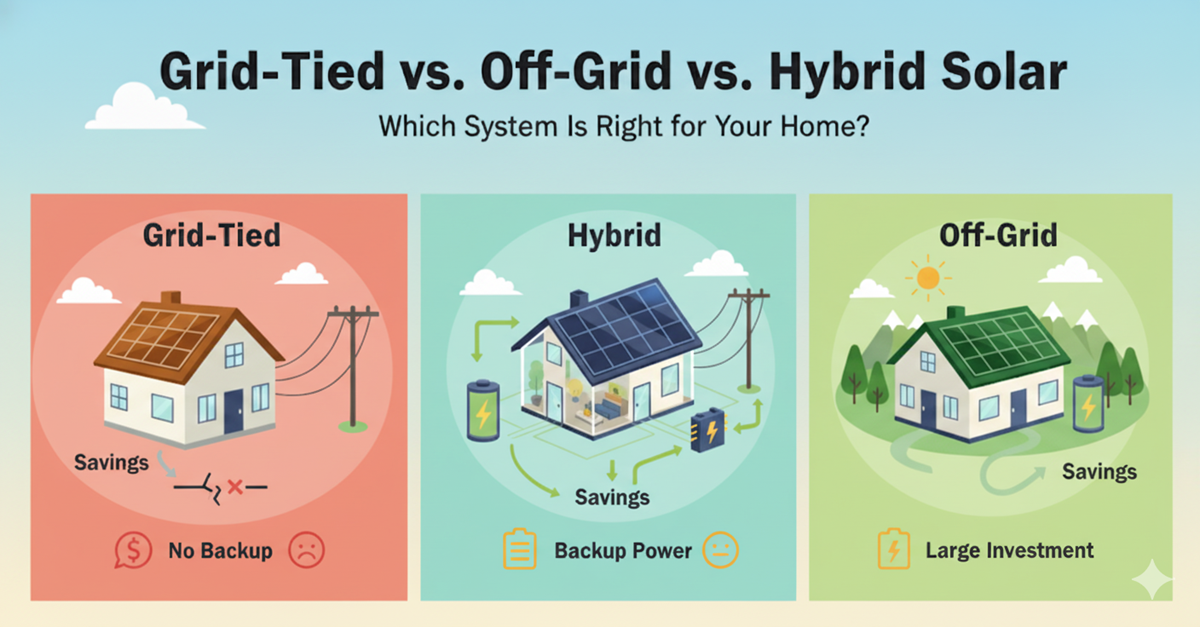
The modern solar landscape offers three main system architectures—each with unique benefits and challenges. This guide compares grid-tied, off-grid, and hybrid solar, building in the critical role of battery storage for resilience and future-proofing.[1, 2, 3]
Key Takeaways
- Grid-tied systems maximize savings through net metering but provide no backup during outages.[2, 3]
- Hybrid systems (grid + battery) are now the most popular, blending bill savings with reliable backup.[4, 5, 1]
- Off-grid systems offer true energy independence but require substantial investment, large battery capacity, and lifestyle adjustments.[3, 6, 1]
- Advances in battery technology (especially LFP) have reduced costs and expanded options for all system types.[7, 8, 9]
Grid-Tied: For the Budget-Focused Maximizer
A grid-tied solar system connects your panels directly to the utility grid. During the day, you use the solar power you generate, and any excess is sent back to the utility, often earning you net metering credits that lower your electricity bill. This is the simplest and most cost-effective way to go solar, designed for maximum financial return in areas with reliable power grids and strong utility compensation rates. However, for safety reasons, these systems automatically shut down during a blackout, leaving your home without power.[6, 2, 3, 4]
- Best For: Homeowners in areas with a stable grid and excellent net metering policies who are focused on the fastest possible return on their investment.
- Considerations: Provides no backup power during an outage. Its financial benefits are highly dependent on local utility policies.
Off-Grid: For the Ultimate Independent
Going off-grid means complete disconnection from the utility. This architecture is designed for total energy independence, requiring a large solar array, a massive battery bank to store power for several days, and often a backup generator for long stretches of poor weather. While it frees you from utility bills and blackouts, going off-grid requires a significant upfront investment and careful energy management. It’s the ultimate solution for remote properties or for those who prioritize 100% self-sufficiency above all else.[1, 3, 6]
- Best For: Remote homes without access to the utility grid, or homeowners who are committed to complete energy sovereignty.
- Considerations: Highest upfront cost by a significant margin. Requires oversized solar and battery systems and careful lifestyle adjustments to manage energy consumption.
Hybrid: For the Resilient All-Rounder
Hybrid systems offer the best of both worlds: they are connected to the grid but also include a battery storage system. This setup allows you to enjoy the financial benefits of net metering while also having reliable backup power the moment an outage occurs. Hybrid systems are the modern standard because they provide both daily savings and emergency resilience. Smart inverters and energy management systems allow for sophisticated control, such as prioritizing essential loads during an outage or using stored battery power to avoid high “time-of-use” rates from the utility.[8, 10, 4, 1]
- Best For: The majority of modern homeowners. It’s ideal for those who experience occasional power outages, live in areas with poor net metering rates, or want to future-proof their home for additions like an EV or a heat pump.
- Considerations: Higher upfront cost than a simple grid-tied system. Requires professional expertise to properly size the battery for your specific backup needs.
Choosing the Right System: A Quick Comparison
| Type | Cost Range | Backup Power | Complexity | Net Metering? |
|---|---|---|---|---|
| Grid-tied | $15k–$25k | No | Simple | Yes |
| Hybrid | $25k–$50k | Yes (some) | Moderate | Yes (~) |
| Off-grid | $50k–$100k+ | Yes (full) | High | No |
For most homeowners in 2025, a hybrid system offers the ideal balance of grid savings, reliable backup power, and the expandability needed for a modern all-electric home.[7, 8]
Professional Installation Is Critical for Success
While a simple grid-tied system is relatively straightforward, hybrid and off-grid systems require expert design and electrical installation to ensure safety, reliability, and code compliance. Critical calculations for battery sizing, load management, and smart component integration are far more complex than for solar alone. Always choose certified professionals for the design and installation of any system that includes battery storage.[11, 12, 13]
References
- Off-grid, Grid-tied or Hybrid: Which Option Is Best for You? – GreenSpark Solar. https://greensparksolar.com/2025/04/07/solar-and-ev-charging-for-your-home/
- Grid-Tied vs Off-Grid Solar Systems – Gexa Energy Blog. https://learn.gexaenergy.com/article/grid-tied-vs-off-grid-solar-systems
- Solar System Types Compared: Grid-Tied, Off-Grid, and Hybrid – SolarReviews. https://www.solarreviews.com/blog/grid-tied-off-grid-and-hybrid-solar-systems
- Solar Systems Explained – Solar Electric Inc. http://www.solarelectricinc.com/solar-electric-system-types
- The 2025 Guide to Solar Home Batteries – Clean Energy Reviews. https://www.cleanenergyreviews.info/blog/guide-how-to-select-solar-hybrid-battery-back-up-system
- Why do most people choose grid-tied solar rather than off-grid? – Reddit. https://www.reddit.com/r/solar/comments/1kqjd67/why_do_most_people_choose_gridtied_solar_rather/
- Enphase IQ Battery 5P vs Tesla Powerwall 2: Which is Right for You? – PSC Energy. https://www.pscenergy.com.au/blog/enphase-iq-battery-5p-vs-tesla-powerwall-2/
- Tesla Powerwall vs. Enphase: Our Honest Review (2025 Guide) – IntegrateSun. https://www.integratesun.com/post/tesla-powerwall-vs-enphase
- Study: Solar Battery Longevity and Reliability – SolarInsure. https://www.solarinsure.com/solar-battery-longevity
- Home Battery Backup Without Solar: The Ultimate Guide – FranklinWH. https://www.franklinwh.com/blog/whole-house-battery-backup-without-solar
- Is Energy Audit Important Before Installing Solar Energy System? – Regen Power. https://regenpower.com/is-energy-audit-important-before-installing-solar-energy-system/
- Professional Home Energy Assessments – U.S. Department of Energy. https://www.energy.gov/energysaver/professional-home-energy-assessments
- Home Battery Storage 101: Everything You Need to Know in 2025 – Volts.ca. https://volts.ca/blogs/educational/home-battery-storage-101-everything-you-need-to-know-in-2025
