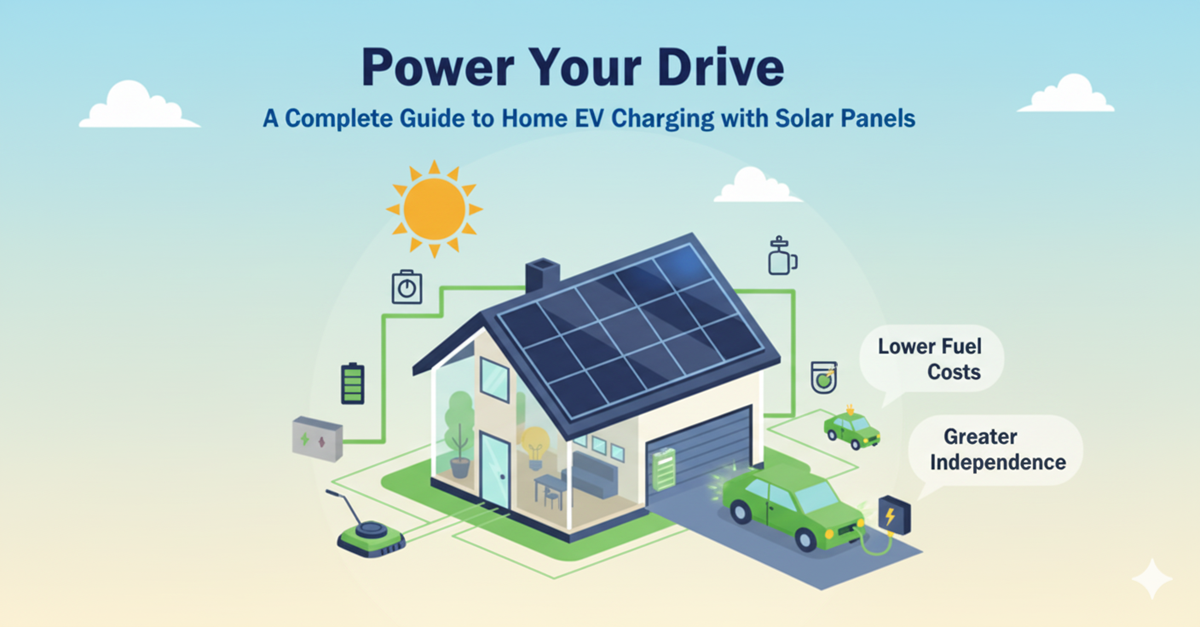
Pairing home EV charging with solar panels has become the “next step” for thousands of modern households. For new and existing EV owners alike, integrating solar means lower fuel costs, greater resilience, and the ultimate energy independence. This guide covers the essentials—charger types, system sizing, cost breakdowns, and smart energy management—backed by current sources for confident decision-making.[1, 2]
Key Takeaways
- Solar EV charging saves hundreds each year vs. gasoline or grid charging.[2, 1]
- Level 2 chargers (240V) provide fast, flexible charging essential for solar-equipped homes.[3, 4]
- Most families need to add 2-4 kW of solar panels per EV to cover their driving energy needs.[5, 2]
- Smart chargers sync with solar output for true “fuel-from-the-sun” independence.[6, 7]
- Home battery storage enables overnight EV charging with stored solar energy.[8, 1]
Why Pair Solar and EV Charging?
Electric vehicles consume a significant amount of electricity, typically around 30 kWh for every 100 miles driven. When you charge from the grid, your costs are subject to fluctuating utility rates and expensive time-of-use charges. By charging with your own solar panels, you effectively lock in the price of your vehicle’s “fuel” for decades. In areas with poor net metering policies, using your excess solar power to charge your car is far more valuable than sending it to the grid for pennies on the dollar.[9, 1, 2]
Smart charging maximizes solar self-consumption, not only reducing costs but also boosting your home’s sustainability and grid independence.[7, 6]
Level 1 vs. Level 2 Charging: What’s the Difference?
| Feature | Level 1 (120V) | Level 2 (240V) |
|---|---|---|
| Install Cost | Included/Free | $500 – $2,000 |
| Miles Added Per Hour | 3 – 5 miles | 12 – 25+ miles |
| Best Use Case | Light daily driving / Overnight top-up | Daily charging / Full charges |
While a Level 1 charger (which plugs into a standard wall outlet) is sufficient for some light commuters, a Level 2 charger is essential for most households, especially for maximizing solar integration. Operating on a dedicated 240V circuit, its faster charging speed allows it to absorb a significant amount of solar energy during peak production hours in the middle of the day.[4, 11, 3, 5]
Sizing Your Solar Array for EV Charging
To accurately size a solar addition for your EV, you can do a quick calculation. First, estimate your annual energy needs. If you drive 12,000 miles per year and your EV’s efficiency is 3 miles per kWh, you will need 4,000 kWh of extra energy annually (12,000 miles / 3 miles per kWh).
Next, determine how much of a solar array you need to generate that energy. If you live in an area where 1 kW of solar panels produces 1,500 kWh per year, you would need to add approximately 2.7 kW of new solar panels (4,000 kWh needed / 1,500 kWh per kW) to cover your driving needs. A professional installer can provide a precise calculation based on your specific location and driving habits.[2, 5, 9]
Smart Charging, Batteries, and the Future of EV Integration
Modern smart chargers are the key to maximizing solar self-consumption. They monitor your home’s energy usage and your solar panels’ output in real-time, automatically enabling EV charging only when there is excess solar power available. Key features include:
- Solar-Aware Charging: The charger automatically adjusts its speed or pauses charging to ensure your car is “fueled” by the sun, not the grid.
- Scheduled Charging: You can program the charger to operate during specific off-peak hours to take advantage of the lowest utility rates.
When you add a home battery to the system, you gain even more flexibility. You can store your excess solar energy during the day and use it to charge your EV overnight. The most advanced platforms (like Emporia, SolarEdge, and Enphase) can intelligently coordinate all three components, prioritizing your home’s loads first, then charging your battery, and finally routing any remaining surplus power to your EV.[6-8, 1]
Looking ahead, emerging technologies like Vehicle-to-Home (V2H) will allow your EV to function as a backup battery for your house, providing power during a grid outage and offering the ultimate in energy resilience.
What to Look for in a Home EV Charger
When selecting a Level 2 charger, consider these key features to ensure it meets your needs and is compatible with your home:
- Amperage (e.g., 32A, 40A, 48A): Higher amperage means faster charging. A 48A charger can add over 30 miles of range per hour, but it requires your home’s electrical panel to have sufficient capacity.
- Connectivity (Wi-Fi/App Control): Essential for accessing smart charging features, monitoring your energy use, and receiving software updates.
- Cable Length: Ensure the charger’s cable is long enough to comfortably reach your vehicle’s charging port in your garage or driveway (18-25 feet is common).
- Outdoor Rating: If the charger will be installed outside, make sure it has a NEMA 4 or similar rating, which protects it from rain and other weather conditions.
Savings Analysis
Charging an EV with solar power costs approximately $0.10 per kWh or less, depending on the installed cost of your system. This makes the “fuel” for 100 miles of driving about $3. In comparison, the same distance would cost $7–$12 for a gasoline-powered car or $3.60–$7.50 when charging from the grid. These ongoing savings, combined with tax incentives for both solar and EV chargers, can dramatically shorten the payback period for your investment.[12, 13, 1, 2]
Professional Installation and Electrical Considerations
Installing a Level 2 charger is not a DIY project. It requires a dedicated 240V circuit, a permit in most areas, and often an upgrade to your home’s main electrical panel. A qualified electrician is essential to ensure the installation is safe, code-compliant, and optimized for your home’s electrical system. Discuss the integration of a smart charger with your solar installer to ensure seamless communication between all components.[14, 15, 3]
References
- Solar and EV Charging for Your Home – GreenSpark Solar. https://greensparksolar.com/2025/04/07/solar-and-ev-charging-for-your-home/
- Solar EV Charging – Palmetto. https://palmetto.com/home-electrification/solar-ev-charging
- Level 1 vs. Level 2 EV Chargers – Palmetto Solar. https://palmetto.com/home-electrification/level-1-vs-level-2-ev-chargers
- EV chargers: Level 1 vs. Level 2 – SRP blog. https://blog.srpnet.com/electric-vehicle-chargers/
- The Complete Guide to Electric Vehicle (EV) Solar Panel Charging – EcoFlow. https://www.ecoflow.com/us/blog/guide-to-electric-vehicle-solar-panel-charging
- Solar EV Charging: What You Need To Know – Emporia Energy. https://www.emporiaenergy.com/blog/solar-ev-charging-what-you-need-to-know/
- Scheduling EV Charge Time – SolarEdge. https://www.solaredge.com/us/support/system-owner/scheduling-ev-charge-time
- Excess Solar | Emporia Home Energy Management Platform. https://www.emporiaenergy.com/home-energy-management/excess-solar/
- Charging an EV From Solar: Is It Viable? – ev.com. https://ev.com/news/charging-an-ev-from-solar-is-it-viable
- What Are The Differences Between Level 1 and Level 2 EV Chargers? – Qmerit. https://qmerit.com/blog/intro-to-level-1-and-level-2-ev-charging-at-home/
- Home Solar EV charging explained – Clean Energy Reviews. https://www.cleanenergyreviews.info/blog/solar-ev-charging
- Electric Cars Benefits: Complete 2025 Guide To EV Advantages. https://solartechonline.com/blog/electric-cars-benefits-guide-2025/
- Thinking About Going Electric or Solar? Here’s Why You Shouldn’t … https://www.jrcpa.com/thinking-about-going-electric-or-solar-heres-why-you-shouldnt-wait/
- Is Energy Audit Important Before Installing Solar Energy System? – Regen Power. https://regenpower.com/is-energy-audit-important-before-installing-solar-energy-system/
